Loading...
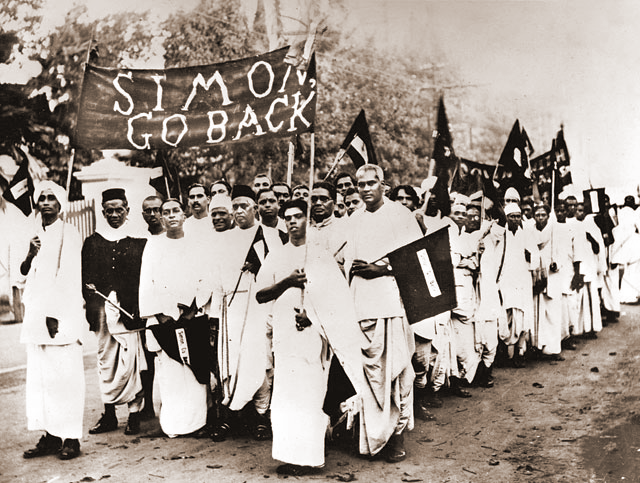
Simon Go Back
In November 1927, the British Government announced the appointment of a royal Commission headed by Sir John Simon, to report on the working of the constitutional reforms of 1919, and on the possibilities of further advance towards self-government. The commission included representatives of the British political parties, but no Indian. The “all-white” commission came to be looked upon in India as an inquisition by foreigners into India’s fitness for self-government. The Indian National Congress decided to boycott the commission “at every stage and in every form”. Even moderate and Muslim politicians, whose cooperation the Government had taken for granted, were unanimous in denouncing the commission
A challenge from Birkenhead, the Conservative Secretary of State, stung Indian leaders to seek an agreed solution of the constitutional problem. An All-Party committee headed by Motilal Nehru drafted a constitution for a self-governing India. The “Nehru Report” adopted Dominion Status as the basis of its recommendations; it represented the lowest measure of agreement among the Congress, the “Liberals” and the other political groups. The younger wing of the Congress led by Subhash Chandra Bose, the brilliant young leader from Bengal, and Motilal Nehru’s own son, Jawaharlal, repudiated Dominion Status. A rift was avoided at the Calcutta Congress in December 1928 by a compromise formula framed by Gandhi. A resolution was passed endorsing the Nehru Report on the condition that, if by December 31, 1929, it was not accepted by the Government, the Congress would fight for complete independence, if necessary, by resorting to non-violent non-cooperation.
The Calcutta Congress opened the way for Gandhi’s return to politics. If the British Government did not concede that demand of the Congress—and there was little prospect of their doing so—the Congress was committed to a non-cooperation movement and it was obvious to all that Gandhi alone could conduct it.
In May 1929, as the result of the British General Election, a Labour Government headed by Ramsay MacDonald came into office. The Viceroy, Lord Irwin, visited England and, on return to India towards the end of October 1929, issued a statement that it “is implied in the declaration of 1917 that the natural issue of India’s constitutional progress, as there contemplated, is the attainment of Dominion Status”. The statement had a favourable reception in India, but a storm broke over Irwin and the Labour Government in England. The British press and Parliament subjected the announcement to a protracted postmortem. The official spokesmen were on the defensive, explained away the statement, and asserted that there had been no radical departure from past policy. The breach between the Government and the Congress thus remained unhealed. No more success attended an eleventh-hour effort at an understanding between Gandhi and the Viceroy through an interview arranged at Delhi on December 23, just before the Congress session at Lahore.

