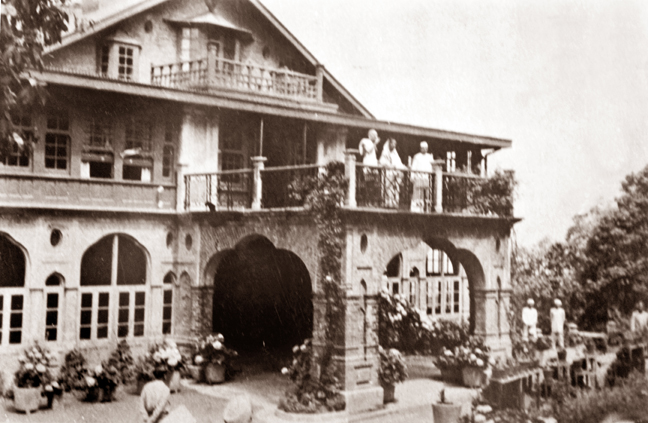
In the summer of 1945, a conference was convened at Simla by the Viceroy, Lord Wavell, who had recently returned from England with the approval of the British Cabinet to a proposal for reconstituting the Executive Council in consultation with Indian leaders. Gandhi was not a delegate to the conference, though he was consulted by the Viceroy and the Congress Working Committee. The conference broke down on the insistence of Jinnah that his party should have an exclusive right to nominate Muslim members of the Viceroy’s Executive Council. This was something which the Congress could not concede without repudiating its national composition.
The Simla Conference failed to break the deadlock, but two important events took place in the wake of the conference which made a new initiative possible. With the surrender of Japan on August 15, 1945, the Second World War came to an end, and the Labour Party came to power in Britain. Lord Wavell visited London, and on return to India, announced on September 19, 1945, that the British Government was still working “in the spirit of the Cripps Offer of 1942” and intended to convene a constitution-making body. Elections to the central and provincial legislatures, which were in any case overdue, were announced. Indian politics was again deeply stirred and entered a period of intense excitement, interminable negotiations and bitter controversy.
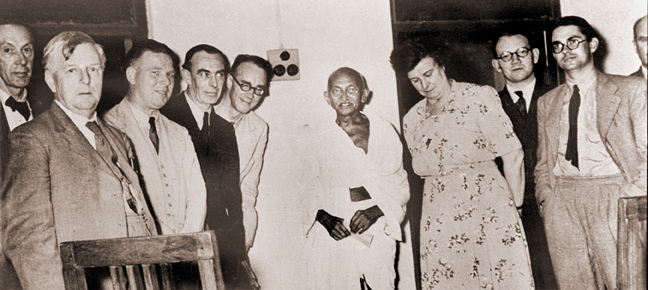
Early in 1946, the Labour Government dispatched an all-party parliamentary delegation to India to meet Indian leaders and convince them of the British desire for an early settlement of the Indian constitutional issue. However, it was only in March 1946 that with the arrival of three Cabinet Ministers, Lord Pethick- Lawrence, Sir Stafford Cripps and Mr. A.V. Alexander, a crucial stage was reached in the negotiations between the British Government and the Indian political parties. The negotiations were conducted on behalf of the Congress by Abul Kalam Azad who was assisted by Nehru and Patel. Gandhi was, however, frequently consulted. The negotiations were bogged down on the basic question whether India was to remain united or to be split up to satisfy the Muslim League’s demand for Pakistan. The Congress opposed to the partition of the country, but was prepared to go to the farthest limit in conceding cultural, economic and regional autonomy to various regions. A conference at Simla failed to resolve the Congress-League differences. The Cabinet Mission then offered a compromise plan in their statement of May 16, 1946. They sketched a three-tier constitutional structure for India. On the top was to be a Union of India embracing British India as well as the Indian State, but dealing only with foreign affairs, defence and communications. The bottom tier was to consist of Provinces and States in which were to vest all residuary powers. The intermediate tier was to comprise “groups” to be formed by Provinces (if they chose) to deal with certain common subjects. The Muslim League avowed its acceptance of the Cabinet Mission, Plan, but this acceptance was more apparent than real. The League and its leaders made no secret of their hope and design that the new constitution would be used to effect a partition of the country. “Let me tell you,” Jinnah told the Muslim League Council on June 5, 1946 “that Muslim India will not rest content until we have established full, complete and sovereign Pakistan.” It was this apparent contradiction in the League’s stand, which made Gandhi and his colleagues in the Congress uneasy about the “grouping of provinces”, which the League wanted to make compulsory and a stepping-stone to Pakistan. The controversy on this issue wrecked the Cabinet Mission Plan.
The three-tier constitution was a delicate mechanism with numerous checks and balances. Without the fullest cooperation between the major parties it was impossible to draft a new constitution, much less to work it. This cooperation was, however, lacking. The Cabinet Mission Plan was a compromise but it did not really bring the two parties together. The result was that questions presumed to have been settled by the Cabinet Mission, were reopened soon after the return of its three members to England Controversy rose to a fever pitch on two crucial issues, that of the “grouping” of provinces and the composition of the “interim government”.